
William Carius finds a unique harmony between the worlds of music and perfume. Both utilize symphonies of “notes” to evoke emotions and memories, connecting with people on a profound level that transcends conscious thought.

I met Will through a mutual acquaintance in the online fragrance community and quickly discovered a kindred spirit. He cherishes both music and scent for their ability to transport us. A single whiff of a fragrance, akin to a familiar chord progression, can instantly whisk you away to a distant time and place, triggering a torrent of emotions undimmed by years.
In this conversation, Will and I explore his unique perspective on the connection between music and fragrance, their shared language, and their power to bypass the intellect and touch the soul. He also shares the perfumes and pieces of music that have become his personal anthems, each a multi-sensory story waiting to be experienced.
Prepare to embark on a journey where fragrance dances to unheard melodies and music paints vivid olfactory landscapes.
What initially sparked your interest in perfume?
My journey into the world of fragrance began in San Francisco during a legal internship in 2013. My housemate had recently lost her mother and was looking for a friend. One day, she suggested exploring the perfume boutiques in Union Square. Despite knowing little about perfume myself, I was intrigued by the idea and readily agreed.
Our first stop was Saks Fifth Avenue, where we encountered a dedicated Penhaligon’s representative. Barney’s, known for its diverse perfume selections with lesser-known brands, was another stop. It was there that I discovered names like Yosh, Ormonde Jayne, and Heeley. I remember encountering a fancy Frederic Malle display that misted you with fragrance as you walked through it.
Over time, my housemate and I bonded over a shared love of perfume and she taught me a great deal, particularly about vintage fragrances and the old masterpieces.
When did you start seeing perfume as an art form?

My appreciation for perfume as art blossomed with a challenging encounter: Bitter Rose Broken Spear from the Hylnds collection by DS & Durga. It wasn’t love at first sniff. In fact, it was quite the opposite. Here I was at Barney’s, exploring their niche fragrance section, and this scent…well, it reeked. It smelled of blood, hot metal, gunpowder, flowers, and decay. Unpleasant, yes, but undeniably captivating.
Bitter Rose, Broken Spear defied expectations. It wasn’t designed to be a crowd-pleasing fragrance. It was a bold artistic statement, a symphony of jarring notes that evoked imagery of battlefields and death. It challenged my concept of what fragrance can and should be, and blurred the line between artistic expression and mass appeal. While some might argue masterpieces live at the intersection of beauty and wearability, Bitter Rose, Broken Spear showed me the power of pushing boundaries. It was daring and unforgettable and forever changed how I view perfume.
You perceive a strong connection between fragrance and music. Can you elaborate on this link?
I think there’s a strong mechanical connection. Both fragrance and music rely on peculiarities of physics for their effects. High notes in music, like those played on a flute, are similar to top notes in perfume. They’re both higher energy molecules, more volatile, and therefore have a sharper and clearer character. People also use a lot of shared language when they talk about fragrance and music. We use similar terms to describe both, like “chords” and “notes.”
More than that, both music and fragrance are intangible art forms. They have the ability to speak directly to emotions and memories, reaching out and touching the soul. Think of a song that instantly takes you back to a specific time in your life. Perfumes can do the same.
Unlike visual arts like painting, music and fragrance aren’t dependent on external context. You don’t need knowledge of art history to appreciate a beautiful melody or for a rhythm to quicken your heartbeat. A scent can be moving on its own, echoing scents and emotions you’ve smelled and felt before without explanation. These art forms bypass the intellectual and connect straight to deep, vulnerable parts of us in ways other art forms often cannot.
Tell me about a fragrance that has deeply affected you.
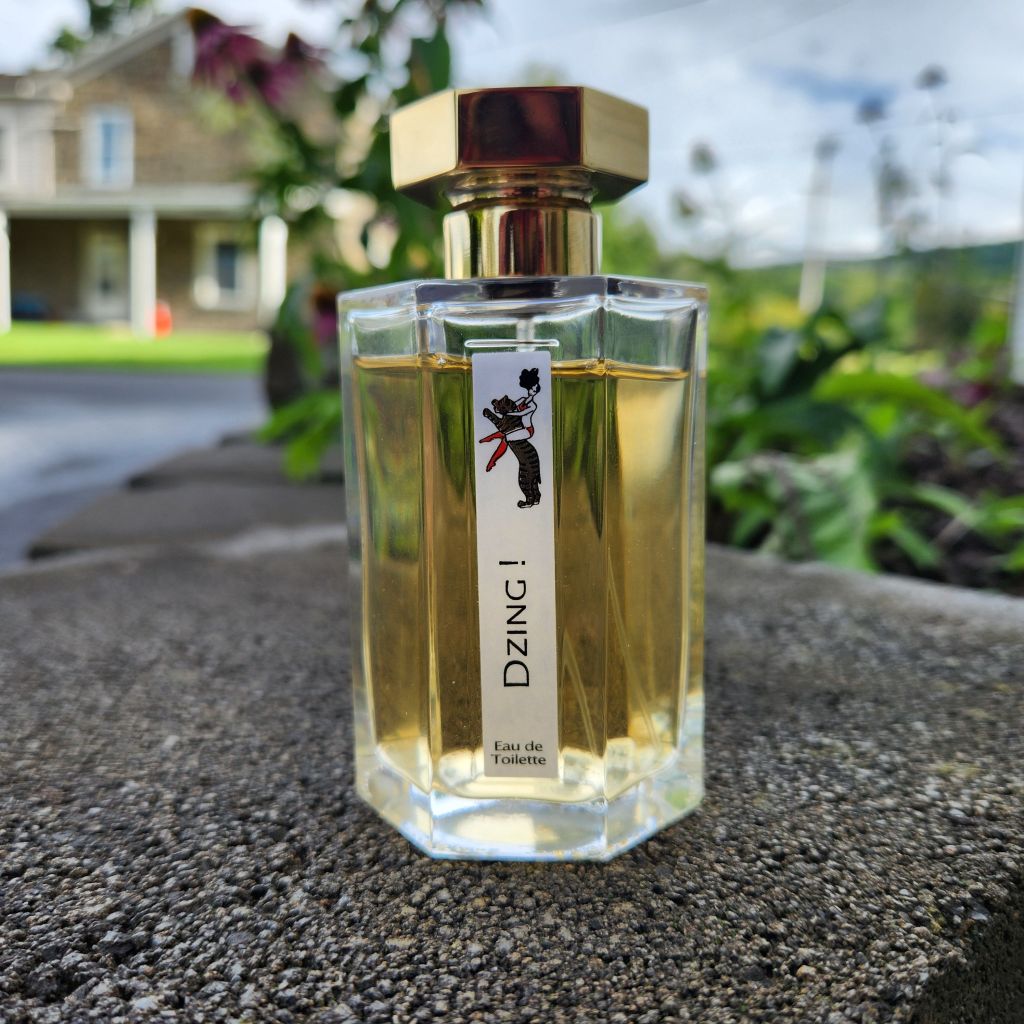
Without a doubt it’s Dzing! by L’Artisan Parfumeur. Dzing! was the perfume that taught me fragrance wasn’t just about smelling good, or even about making art. Dzing! was the first perfume that made me cry.
I grew up in upstate New York. My dad worked in New Jersey during the week and would commute home on the weekends. When he came home, he often took me to see the little circus that performed at the local State University of New York campus. It was our special tradition, just him and me, on Saturday nights. We would get popcorn and sit on the bleachers, captivated by the spectacle. Those were among the most special nights of my life.
To me, Dzing! smells like that circus. It smells of popcorn, warm cardboard, caramel apples, animalistic notes, wood chips, leather, and unwashed carnies, all in the best possible way. It captured a precious part of my childhood in a way that I thought nothing ever could. I was devastated when they discontinued it, but prize my bottle all the more. Dzing! is my comfort scent if I’m having a bad day.
Is there a piece of music that you find as personally meaningful as Dzing!?
Absolutely. Just like that fragrance, George Gershwin’s Rhapsody in Blue evokes powerful personal memories. My dad was a trumpet player in his youth and has always aspired to learn both the trumpet and piano parts for Gershwin’s masterpiece. He has never quite managed it, but it’s always been a dream. This is part of what inspired my interest in piano, and I’ve been working on mastering this piece myself for many years.
Beyond the sentimental connection, Rhapsody in Blue is just a fantastic piece of music. It’s vibrant, energetic, and, in many ways, represents the very best of both my father and orchestral jazz. I smile every time I hear it.
If you were to compose a fragrance based on Rhapsody in Blue, how would you do it?

Rhapsody in Blue is a complex piece, and translating it into fragrance would be a significant undertaking. My starting point would be vetiver, but not the raw material itself.
- The clarinet: Vetiverol and vetiveryl acetate offer a clean, warm profile, which is crucial. I think these ingredients would help me capture the piece’s signature clarinet note. I might also add a blue lavender accord, balanced against exaltolide and muscenone, to bring some tone and space to the core concept.
- The piano: The piano’s tone has a “nutty” quality to my ear, like the aural equivalent of acorns. Fine bourbon vetiver can be beautifully nutty on its own, and I think that facet could be emphasized to capture the woody richness of the piano part.
- Brass: Brass instruments reminds me of caramel, so that’s probably how I’d try to explore that particular part of the music. The fact that it works well with vetiver and nuts adds to the internal harmony.
How do you perceive certain musical genres captured in fragrances?
Music and fragrance share a powerful ability to evoke emotions and conjure imagery. Here’s how I see some genres reflected in scents:
- Blues: Caron’s Narcisse Noir perfectly captures the essence of the blues for me. The perfume reminds me of a smoky 1920s nightclub, which, for me, is in Paris, even though the heart of the blues lies elsewhere.
- Pop Culture Icons: Tommy Girl by Tommy Hilfiger s a product of its time, instantly bringing Britney Spears to mind. It’s light and carefree and is about as complete a representation of ‘90s pop as I think will ever exist in the fragrance world.
- Glam Rock: To me, Poison by Dior makes me think of Cyndi Lauper’s exuberance and the androgynous glam rock scene of the ‘80s, reminiscent of KISS. It’s bold and playful.
- Psychedelic Era: Halston Z-14, with its stylish blend of lemon, cinnamon, vetiver, and raspberry, transports me to the early psychedelic years of Pink Floyd. While the fragrance postdates that period, its unique combination creates a trippy and evocative experience.
- Classic Rock: Chanel Pour Monsieur by Henri Robert, particularly the vintage version, reminds me of The Eagles’ song “Journey of the Sorcerer.” The peach-moss character of the perfume and the opening banjo of the song both make me think of the yellow-orange of an early sunset, though I’ve never been able to really explain the association.
All of that said, these are my own impressions and experiences. What a song evokes in one person might be entirely different for another. Music, like perfume, is singularly personal.
Tell me about some trends in music and perfume that concern you. Are there any trends that excite you?
In general, I find music less interesting now than it was 70, 50, or even 30 years ago, and the same is often true of perfume. There’s a trend in both music and perfume where it feels like they’ve been designed by focus groups and algorithms, with an over-reliance on formulaic structures and crowd-pleasing approaches that stifle creativity. Similarly, both music and perfume are often overproduced, overwrought, and built around little “bites” instead of full works. When every detail is smoothed out and polished, when all that matters is a thirty-second interaction, it removes the raw emotion and character that makes art truly connect with people.
As Henry Ford said, if he had asked people what they wanted, they would have said faster horses. The crowd doesn’t always know what it wants or what is possible. Great art isn’t created by committees.
That said, I also see some fascinating work going on right now in perfumery, reconstructing lost bases from the Golden Age and discovering and creating completely new raw materials. For example:
- Jamie Frater’s work to reconstruct the lost bases of Golden Age perfumery, especially his resurrection of Persicol, Prunol, and Cedarome.
- Paul Kiler’s efforts to develop new base materials, especially his black tea and lemon bases, which are both incredible.
- The development of new aroma molecules such as Cetalox, Cashmeran, and Nympheal, which have tremendous potential. However, the problem with such materials is that it’s easy for them to become crutches, and both Cetalox and Cashmeran have already suffered an ignominious fate.
In both perfume and music, I would like to see those who innovate recognized for their artistry and daring. I see this happen in the niche world in perfumery, but I don’t see anything similar happening in music. So much of commercial music seems so uniform, so corporately curated, that everything feels like it’s beginning to blend together. It’s disheartening that those who achieve the most commercial success seem to do so because of their ability to fit a prescribed mold.
My hope is that, in the future, streaming services go by the wayside and there is greater access and visibility given to independent artists. There are so many talented folks out there, so many gifted musicians and perfumers. That so many of them are not getting the recognition they deserve is tragic.
Editor’s note: William Carius is the nose behind Barrister & Mann, a company that makes grooming products for shaving as well as a range of fragrances.
The headshot and perfume image have been provided courtesy of Will Carius. All other images are royalty free images from Pixabay.
Like what you’ve read here? Please leave a comment and share this post.
Thanks for joining me for this fourth installment of Fragrances With Friends.
See ya later!






 Fragrances With Friends