
If my friend, Anne Gray, were to write an autobiography, it would undoubtedly be scratch-and-sniff.
Fragrance has always been a central element in Anne’s experience of the world. She’s fascinated by the intricate interplay of scent, memory, and emotion. A veterinarian by training, Anne wishes she could understand how her doggie patients perceive and remember their environment through scent.
In this Q&A, Anne explores the ways she has purposefully used perfume to recollect her past, alter her mood, and enrich her spirit. She also shares ways she thinks the perfume industry can better serve consumers: by becoming less prescriptive and more responsive to consumer curiosity.
Can you share a personal story about a perfume that has a particularly strong emotional connection for you?
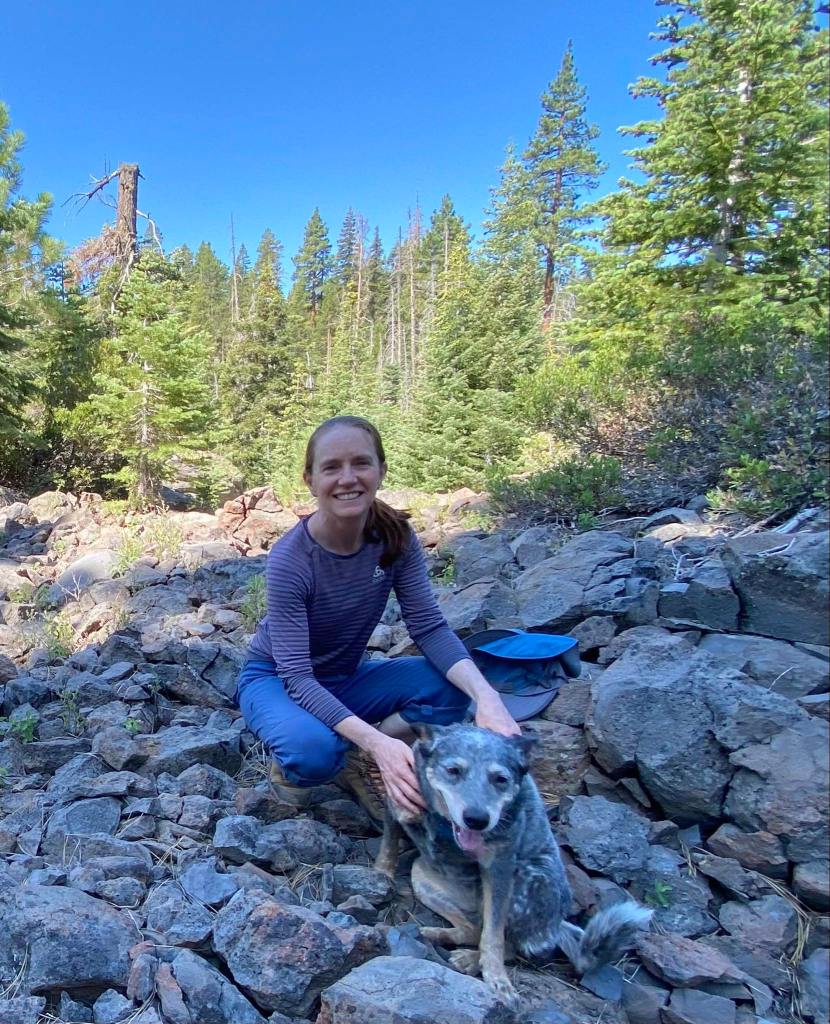
I’ve always been fascinated by the power of certain scents to evoke powerful memories. Today, when I wear Guerlain Neroli Outrenoir, I’m instantly transported back to a time when I used to wear it while social dancing and performing.
Knowing the evocative power of perfume, I’ve consciously chosen to wear specific scents at certain times to create positive associations. For example, I always wear Serge Lutens Five O’Clock au Gingembre for Christmas tree chopping in the snowy foothills, and Dior Midnight Poison on Halloween. These fragrances remind me of the joy and happiness of those times with friends.
Unfortunately, there’s also a bittersweet side to my scent memories. During my college and veterinary school years, rose essential oil was my constant companion. However, those years were filled with a lot of stress and unhappiness, and now, whenever I smell a rose-centered perfume, it takes me right back to that difficult time. To this day, I avoid rose-forward scents.
In my physiology training, we learned about the close proximity of the memory and olfactory centers in the brain. This likely plays a significant role in forming strong associations between scent, memory, and emotion.
Is there a special memory you would like to capture in a fragrance? What is it? What does it smell like?
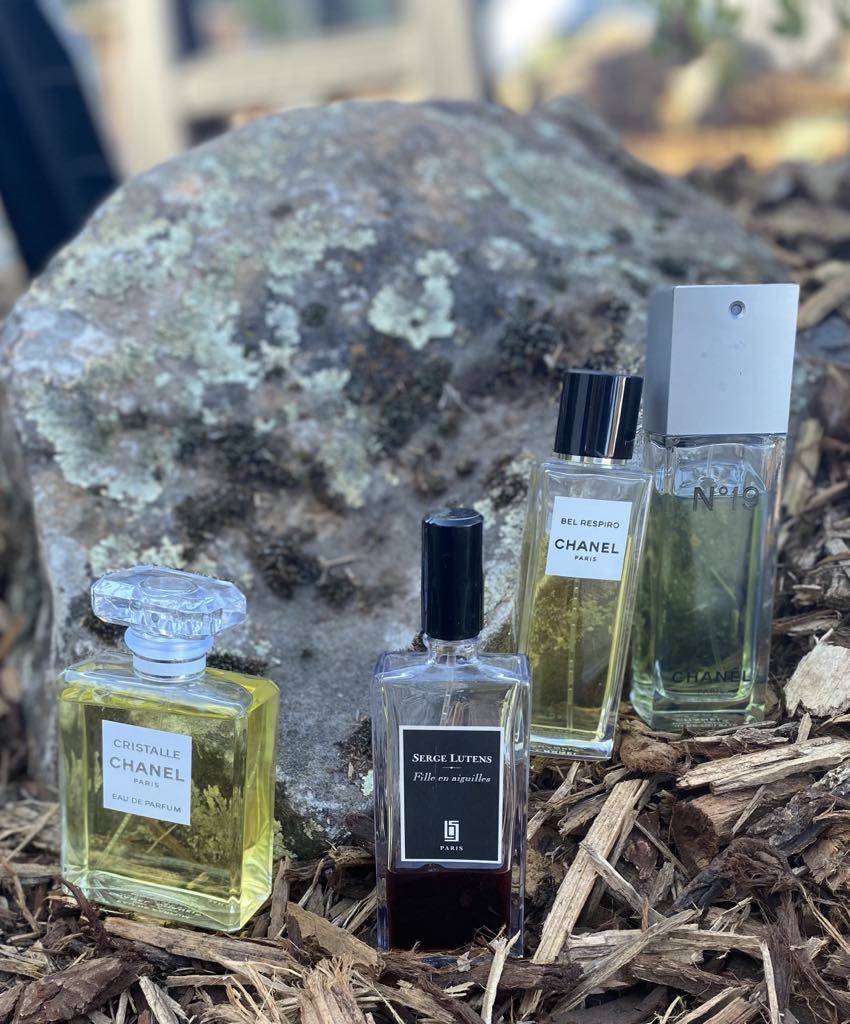
I’d love to create a fragrance that captures the memory of camping with my grandmother in the Sierras. We sometimes spent entire summers together, hiking and learning to identify plants, birds, and various types of rocks. A perfume inspired by this memory would smell like pine needles and sap in the sun, moss growing on tree branches, wet rocks, and tree bark.
Two perfumes that remind me of my grandmother are:
- Chanel Bel Respiro, which smells like grass, dry crushed leaves, sun soaked moss, the leather of hiking boots and a bright morning.
- Serge Lutens Fille en Aiguilles, which smells like pine needles, spicy mulled wine, and a warm, fire-lit cabin.
Bel Respiro is particularly evocative for me, as it immediately made me think of my grandmother the first time I smelled it. To this day, I gravitate toward green and woody fragrances, which I associate with my positive childhood experiences in the outdoors.
You’re a veterinarian as well as fragrance lover. Are there scent-related questions you wish you could ask your patients?
I’m curious about what the world is like through a dog’s nose. Their ability to perceive and remember scents with such detail and specificity is fascinating. I’d like to be able to ask dogs what they smell and what it means to them.
In the clinic, it’s fascinating to watch dogs react to me. For example, if I see a rabbit as a patient, all the dogs I see later that day have a ‘what is this?’ expression when they sniff me. I wonder if they’re simply curious, if they can visualize this rabbit in their mind’s eye, or if they’re vividly recalling a similar rabbit they’ve chased.
Do you believe that fragrance can be used as a tool for self care, or to enhance or regulate your mood?
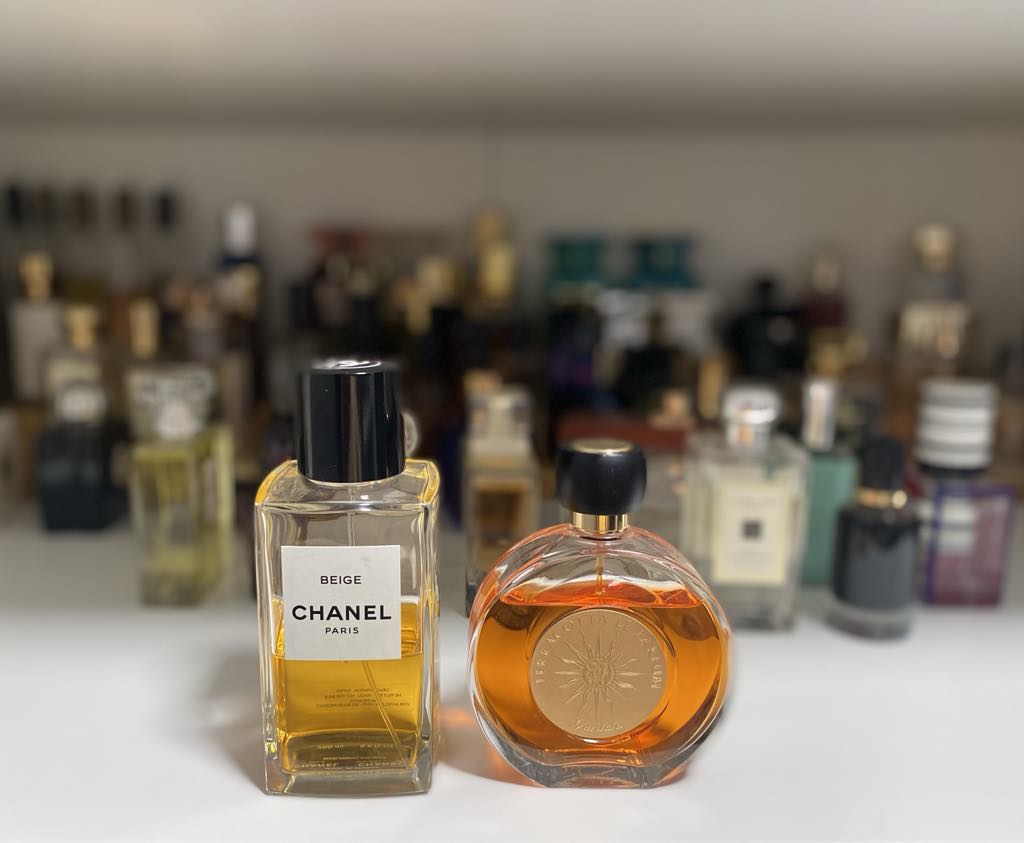
Yes, absolutely. I often choose a scent based on my current mood or how I’d like to feel.
- Happiness: Guerlain Terracotta and Chanel Beige are my uplifting, happy scents. Both of them are sunny and warm; the tropical feel of Terracotta feels like the first day of a vacation, and the florals of Beige are reminiscent of the first flowers of spring.
- Energy: I use Tom Ford Soleil di Positano as my go-to workout fragrance. It’s energizing and easy to wear, and when I put it on, it immediately motivates me to go for a run.
- Confidence: Both Bottega Veneta by Bottega Veneta and Chanel No. 19 EDT make me feel strong and in charge. They are austere yet reassuring, bold and confident.
- A hug from Mom: Amouage Honor Woman reminds me of my mother. It smells like a dry, peppery white flowers with vetiver. It’s the only perfume of mine she’s ever complimented, so it means a lot to me that she appreciates it. I often wear it when visiting her.
- Centered and Calm: Chanel Cristalle EDT or the newly released EDP are my go to fragrances when I want to feel more like myself. They are outdoorsy yet sophisticated, elegant yet playful, and somehow manage to seem both energizing and calming.
There’s a lot of emphasis in the perfume community on pairing fragrances with the seasons and weather. However, for me, it’s more meaningful and useful to focus on how I want the perfume to affect my emotions.
How has your relationship with perfume evolved over time? Have your preferences or emotional connections changed?
I’ve been a dedicated perfume enthusiast for about nine years. It began as a form of escapism from the political and social environment that surrounded me, particularly online. I was seeking something pleasurable and relaxing.
I spent the first few years ‘smelling all the things’ to discover my preferences and emotional connections. Since then—and discovering my love of green and woody fragrances—I don’t think my preferences have changed. If anything, over time, I’ve become more comfortable and confident in embracing my own preferences, regardless of current trends. I know what I like and couldn’t care less about how popular or trendy a scent is.
Knowing the connection between fragrance and memory, how do you think the perfume industry could better serve consumers?
People have strong emotional ties to perfumes and the memories they’re connected to. When beloved fragrances are discontinued, it can feel like losing a piece of oneself. It would be fantastic if a company like Guerlain would occasionally reintroduce discontinued scents based on customer feedback. Doing so would bring joy and comfort to many people, allowing them to reconnect with their past selves, create new emotional memories, and share them with others.
I think the industry could also better serve consumers by taking a hard look at how it promotes perfumes. They often teach people to equate perfume with self-worth and beauty in very limiting ways. Earlier in this interview, I talked about how I use fragrance to give myself energy and confidence, to bring myself comfort, and to remind myself of happy memories. I rarely see perfume advertising try to tell these kinds of stories, and I think that’s a missed opportunity for everyone.
I would like to see the perfume industry expand its vision and turn away from the mass-produced, overly sweet, gourmand, and generically similar ‘blah’ scents that they practically force to be popular through advertising. It would be wonderful if people’s preferences and natural inclinations drove the industry, rather than the industry driving what people reach for.
What advice would you give to someone who wants to explore the scent, memory, and emotion more deeply?
Try a wide variety of fragrances, especially from smaller, independent perfumers who are more likely to focus on the art of scent rather than selling what is considered popular. Here are a few of my favorite perfume brands, each of whom offers a unique range for exploration.
- Dame Perfumery and Jo Malone: These brands are approachable and easy to find, offering soliflors and scents with minimal facets. This will help you identify single fragrance notes and learn what you like.
- Serge Lutens, Olfactive Studio, Imaginary Authors, L’Artisan Parfumeur, and Etat Libre d’Orange: All of these brands create scents that are about capturing a mood, a memory, or a feeling. They are artistic, evocative, thoughtful.
- Pineward Perfumes, Sonoma Scent Studio, Olympic Orchids Perfume, and Dasein: All three of these brands offer extremely realistic, well-crafted scents. I would not start here, since they can be very complex and hard to appreciate on the first sniff. However, even if they’re not for you, you’ll respect their artistry.
As you sniff and sample, pay attention to the emotions and memories each fragrance evokes. Take notes. Over time, this may help you identify what characteristics or fragrance notes are affecting you. This is a good way to learn what you like and why.
Cover image is a royalty-free image from Pixabay. All other images have been provided courtesy of Anne Gray.
Like what you read here? Why not leave a comment or share this blog with someone you know?



 Fragrances With Friends